samedi 28 septembre 2024
Rural Renewal (Verve, 2003)
In the '90s, things became complicated for the Crusaders fans. Keyboardist Joe Sample, and tenor saxman Wilton Felder, recorded 1991's Healing the Wounds as the Crusaders for GRP, and the mid- to late-'90s found Felder and trombonist Wayne Henderson recording for various indie labels as the Jazz Crusaders (despite Sample's objections to their use of that name). Then, in 2002, Sample, Felder and drummer Stix Hooper reunited as the Crusaders -- not the Jazz Crusaders -- and recorded Rural Renewal for Verve. Henderson is the only original member who is absent on this CD, which is surprisingly solid. Because the Crusaders/Jazz Crusaders have been in a state of uncertainly since the '80s and recorded their share of uneven, disappointing albums, one greets Rural Renewal with a certain amount of trepidation. But this release is a pleasant surprise -- in fact, it is arguably the most consistent album that the improvisers have recorded in at least 20 years. And one man who can take some of the credit for that is producer Stewart Levine, who the group worked with extensively back in the '70s. Levine is obviously a positive influence on Rural Renewal, which finds Sample, Felder, and Hooper offering an inspired dose of fusion and jazz-funk. Thankfully, Levine lets the soloists have plenty of room to stretch out. Improvisation is a big no-no on smooth jazz/NAC stations, but this 2002 edition of the Crusaders doesn't pander to radio -- instead, spontaneity prevails for Sample, Felder, and Hooper, as well as trombonist Steve Baxter, Ray Parker Jr. (guitar) and special guest Eric Clapton (who plays guitar on two tracks). Rural Renewal falls short of essential, but it's still a welcome addition to their catalog.
Healing the Wounds (GRP, 1991)
The Crusaders became a part-time group after the early '80s and by 1986 drummer Stix Hooper had departed. This final set by what was left of the group finds the two original members (keyboardist Joe Sample and saxophonist Wilton Felder) sharing the spotlight with bassist-producer Marcus Miller and an oversized rhythm section. The funky music (which includes originals by Sample and Miller in addition to "Mercy, Mercy, Mercy" and a Stevie Wonder piece) is pleasant but not too memorable. Considering the upcoming infighting that found Felder and the group's former trombonist Wayne Henderson forming a "New Crusade" over Sample's objections, the title of this CD is rather ironic.
Life in the Modern World (MCA, 1988)
Nah, this ain't the Crusaders, not these rhythm-programmed, synth-laden, groove-less wonders. And in a way, it isn't the Crusaders; it's Joe Sample and Wilton Felder surrounded by keyboardists, percussionists, and other incompatible production trappings, all calculated to create a jazz/R&B hit album with the formulas of the late '80s. But it's mostly not good music even by the formula's standards, and Sample and Felder sound like electronically distorted facsimiles of themselves. The drummer du jour this time is John Robinson, who like his predecessors doesn't solve the band's post-Stix rhythm problems. About the only time the record does anything worthwhile is when Brazil's Ivan Lins contributes a pair of keening cameo vocals (reportedly his first recorded vocals in English) -- but there again, they're chasing a then-current trend, the cresting of the second Brazilian wave. Such is life in the modern world (sigh).
The Good and Bad Times (MCA, 1986)
The departure of Stix Hooper from the Crusaders basically knocked the main prop out from underneath their interlocked groove, and no combination of drummers and percussionists could put the structure together again. 24-year-old Sonny Emory clearly wasn't the answer to the drumming conundrum; he's competent but stiff when compared to the loosey-goosey Stix. There are only two full-fledged Crusaders left on this session -- Joe Sample and Wilton Felder (Larry Carlton makes a token appearance on "Sweet Dreams") -- and while Sample composed all of the material, hardly any of it strikes fire. Nancy Wilson does a cameo turn on "The Way It Goes," but the tune is a collection of soft-rock clichés, not one of Sample's better inspirations. And most telling of all, this does not sound like a Crusaders record; the rhythm aside, Sample's reliance on harsh-sounding synths deconstructs and desiccates their sound. Pass it by.
Royal Jam (MCA, 1982) with B.B. King
Royal Jam is a live recording by the jazz-funk band The Crusaders with B.B. King, Josie James and the Royal Philharmonic Orchestra.[1] It was recorded at London's Royal Festival Hall.
Standing Tall (MCA, 1981)
Standing Tall is an album by the jazz group the Crusaders, their third studio album with MCA Records. It features singer Joe Cocker as guest artist on two tracks: the 1981 Grammy-nominated song "I'm So Glad I'm Standing Here Today" and "This Old World's Too Funky for Me".
Rhapsody and Blues (MCA, 1980)
The Crusaders' follow-up to Street Life did not result in any additional hits (does anyone remember Bill Withers' vocal on "Soul Shadows?") and found the group's R&Bish music sounding closer to a formula. Each of the three remaining original Crusaders (Wilton Felder on tenor, soprano, alto and electric bass, keyboardist Joe Sample and drummer Stix Hooper), who are joined by an expanded rhythm setion, contribute at least one original apiece but the group's concept was starting to sound a bit tired.
Street Life (MCA, 1979)
Street Life is a studio album by the American jazz band the Crusaders. It was a top 20 album on three Billboard charts and represents the peak of the band's commercial popularity. The title track, featuring singer Randy Crawford, was a Top 40 pop single (No. 36) and became the group's most successful entry on the soul chart (No. 17).[1] It was No. 5 on the UK Singles Chart. "Street Life" also hit the disco chart, peaking at No. 75,[2] and was re-recorded by Doc Severinsen with Crawford reprising her vocal for the opening sequence of the noir crime drama Sharky's Machine, directed by Burt Reynolds in 1981. This faster paced version was also featured in Quentin Tarantino's Jackie Brown, released in 1997.
Although the Crusaders could not have known it at the time, their recording of "Street Life" (which features a memorable vocal by Randy Crawford) was a last hurrah for the 20-year old group. Their recordings of the next few years would decline in interest until the band gradually faded away in the '80s. However this particular set is well worth picking up for the 11-minute title cut and there is good playing by the three original members (Wilton Felder on tenor, soprano and electric bass, keyboardist Joe Sample and drummer Stix Hooper) along with guitarist Barry Finnerty; horn and string sections, plus additional guitarists are utilized on Sample's commercial but listenable arrangements
Images (Blue Thumb, 1978)
By 1978, the Crusaders sans the "Jazz" prefix were past their popular prime, and seemed to be recycling the same ideas that made them more famous when they started playing funkier music. While a limited urban crowd still gravitated toward what was becoming instrumental disco music, the ideas of the group had waned to the point where even commercial radio stations were less interested in this album as a whole. Images offers very little in terms of new or hit music, though Joe Sample attempted to compose songs that built on their prior success, especially like the successful album Free as the Wind from two years prior. Originally on the Blue Thumb label (sold to the MCA mega-conglomerate), this album was on the more commercial side of the label, which also included the National Lampoon LPs, Captain Beefheart, Dan Hicks, Jimmy Smith, T. Rex, and Mark-Almond. Of three tracks penned by Sample, "Merry-Go-Round" is the lowest common denominator, copping the urban funk of the Bill Withers hit "Just the Two of Us"; "Snowflake" is nothing like its delicate, wafting title, instead being too lively and fast; and "Fairy Tales" is the tune closest to overt primal disco. Drummer Stix Hooper contributes "Marcella's Dream," which is passable low-key blues-funk with some nice keyboard work from Sample. Wilton Felder's soul-drenched saxophone remained the high point of any recording the Crusaders did, as he stands out on his tune "Bayou Bottoms," a street-strutting standard-bearer for the era, and one of their better all-time tracks. "Covert Action," however, regresses into hollowed-out music with little heart or real soul. Electric bass guitarist Robert Popwell's "Cosmic Reign" starts out in some pseudo-Sun Ra space trip realm with diffuse synths and a bloogle/sound tube or three, but invariably is dependent on more street funk, and surprisingly even a brief hint of bop. While this is far from the worst -- or the very best -- recording the Crusaders produced in their checkered career, it offers no extra tracks or fresh insight, and is essentially a mediocre effort.
Free as the Wind (Blue Thumb, 1977)
There's a terrific reason why the triple-CD Crusaders retrospective The Golden Years included six of Free as the Wind's eight tracks -- the material. Indeed, side one of the LP version may be the strongest single side of original tunes that the band ever put together. It opens with Joe Sample's driving, tense title cut, and flows flawlessly through Stix Hooper's subtly funky "I Felt the Love," Pops Popswell's infectiously finger-popping "The Way We Was" (a high point in the Crusaders' groove collection), and Larry Carlton's steamy vehicle for Wilton Felder, "Nite Crawler." Even the two tracks that the box set left out -- the galvanic "Feel It," driven by Sample's clavinet and Hooper's tom-toms, and "River Rat" -- are as funky as you can stand it. And from out of the blue, Sample concludes the album with a lovely, wistful tune that may have become a standard, "It Happens Everyday." When the material is this good, everything falls into place from there; the grooves are deeper, the soloing by all five Crusaders is more melodic and probing, and while Sample provides a few brass and string arrangements, this is just harmless decoration, neither a necessity nor a hindrance. This would be the Crusaders' high-water mark in the post-Wayne Henderson years, and it can stand tall with anything they've done.
Those Southern Knights (Blue Thumb, 1976)
Deep in their prime period, the Crusaders reaffirm their affinity with the groove and rely entirely upon all six of their funky selves for their material. "My Mama Told Me So" and "Feeling Funky" contain the most infectious outcropping of the groove, while "Spiral" is OK, yet just a bit too frantic for the groove to thrive. "And Then There Was the Blues" is a laid-back, mildly funky jog at quite some length, where everyone gets a chance to solo extensively; essentially this is the old Jazz Crusaders frontline sound with a funky underbelly. "Til the Sun Shines" is an urbane Larry Carlton ballad with synthesized strings, quite different and to the point, but "Serenity" is a bore, a nothing idea stretched out for too long. The Crusaders' groove machine is still very much in gear, but the fuel is occasionally diluted.
Chain Reaction (Blue Thumb, 1975)
One of the tastiest concoctions of the mid-'70s jazz-fusion era, Chain Reaction finds the Crusaders at the top of their form. The compositions are both accessible and memorable, and the playing is uniformly excellent. Guitarist Larry Carlton delivers some of his finest licks and funkified rhythm work. Wayne Henderson shows there is a place in fusion for the trombone. Wilton Felder does double duty, delivering smoking saxophone lines and funky bass riffs. Joe Sample's Fender Rhodes piano provides a solid chordal foundation and great solos. And the stickman, Stix Hooper, keeps the groove solid. The band employs a variety of rhythms and tempos, and gives the members plenty of room to strut their individual and collective stuff. In fact, "collective" may be the key word here, for this is the sound of a band, not just a group of guys thrown together for a recording session. Chain Reaction was one of the albums that helped lure young, rock and soul-oriented listeners over to check out the jazz side, and should not be missed by those interested in the more accessible, funky side of fusion.
Southern Comfort (Blue Thumb, 1974)
The follow-up to 1973's Unsung Heroes was the first of the group's Blue Thumb efforts to be distributed by ABC Records. The label switch also coincided with the inclusion of lyrical guitarist Larry Carlton as a full-fledged member. Although much of Southern Comfort puts a gloss on ideas made definitive on earlier efforts, the complaints are minimal and this remains the most appealing, multi-faceted incarnation of the band. The first track, "Stomp and Buck Dance," is an offhanded and skilled approach to the group's patently earthy style. The insistent "The Well's Gone Dry" has the edginess of some of the better tracks on Unsung Heroes, and has Carlton doing great work on the bridge. Not surprisingly, it is Carlton's presence here that adjusts the band chemistry and makes the best of Southern Comfort even more so. The best track here, the poignant "When There's Love Around," has Carlton's guitar attaining the perfect sense of longing that meshes well with Joe Sample's trademark Fender Rhodes tones. The last tracks here are also in a thoughtful ballad vein: "Lilies of the Nile" has great horn work from Wilton Felder and Wayne Henderson, and the last track, "A Ballad for Joe (Louis)," is a heartfelt rumination on the life of the famed boxer, featuring Sample's inherent sense of melody. A good representation of the Crusaders' tasteful and intelligent playing, Southern Comfort is more than recommended to their fans.
Scratch (Blue Thumb, 1974)
Recorded live at the Roxy, Scratch was one of the Crusaders' best recordings, an extravaganza of jazz and funk with great soloing from the group on top of a set of excellent grooves. From the loose-limbed funk of "Scratch" to a restless, understated version of their live standard "Eleanor Rigby" (which they'd been performing live for over six years), the Crusaders displayed a command of R&B forms in a jazz context. Another cover, Carole King's "So Far Away," is betrayed by a muddy '70s arrangement and sound, but nothing else here fails to illustrate the excellence of the best R&B group in the jazz world.
The 2nd Crusade (Blue Thumb, 1973)
Given the critical and commercial success of 1 and their rebirth as the "Crusaders," the band decided to follow up the previous LP's double length with another one! There are 13 tunes here, all extrapolating the band's previously held notions of soul-jazz and hard bop as they emerged into the new funky '70s. Textures were a little different this time out as keyboardist Joe Sample expanded his palette to include not only the Fender Rhodes but also his first (subtle) forays into synthesizer, while Wayne Henderson and Wilton Felder keep the crisp horn charts popping throughout. Stix Hooper was, at the time, the best soul-jazz drummer in the business with the possible exception of Idris Muhammad. The newly acquired, three-piece guitar choir led by Larry Carlton is everywhere in evidence here, but the real change is in the place of the bass in this mix. Chuck Rainey, who lent his fat warm electric bass tone to the previous outing, has been replaced by Felder's crisper, more rhythmic approach to the instrument. For the most part, the tunes are shorter here and rely far more heavily on groove aesthetics rather than jazz syncopations. Stewart Levine, ever the chameleon in the producer's chair, directed the sound to its more aggressively funky destination. There is plenty of singing soul here as evidenced by the opener, Sample's "Don't Let It Get You Down," which has a house-party feel and plenty of handclapping to keep the flow of the tune both easy and steady. The minor to major key strut of Henderson's "Take It or Leave It" is one of his first forays out of the striated harmonic charts he'd always written and into something so straight and direct it's jarring -- but killer nonetheless. Felder's "Look Beyond the Hill" could have been an instrumental dub version of something from the first Steely Dan album and has real resemblance in tone, texture, and tune to "Dirty Work." But the real surprise here is Stix Hooper's "Journey From Within." It's an Eastern-tinged modal groove with Carlton's guitar stinging in the middle around Sample's acoustic piano and Felder's loping bassline that becomes the pulse of the track. When the horns begin to move off the melody into solo territory, it becomes one of the first "out-jazz" funk tunes! The two longest cuts on the set are by Sample and serve as the hinges of the album coming as they do in the middle. "A Message From the Inner City" and "A Search for Soul" are both searching tunes that rely on lean, mean backbeats and breaks and both mess about with dynamic tension in unique ways. While the former tune is nearly pastoral in its tentative creation of the groove, the latter stutters and stars and moves off-kilter into a fluid whole. And while it's true that no single track stands out as much as the band's read of Carole King's "So Far Away" on 1, 2nd Crusade is just as consistent and enduring as its predecessor and may be more suited to the dancefloor. But make no mistake: this is a jazz record with greasy funk at its core, not a jazzy funk record.
Crusaders 1 (Blue Thumb, 1972)
In 1971, the Jazz Crusaders reinvented themselves for the first time. First they dropped the word "jazz" from their moniker, and secondly they wholeheartedly embraced electric bass and guitars in their mix. Their new "debut" is a wonder of jazz-funk as a natural evolution out of hard bop and soul-jazz. While the wonderful horn interplay between saxophonist Wilton Felder and trombonist Wayne Henderson is still everywhere evident, the badass, beat-driven rhythm section has Joe Sample playing funky Rhodes piano against Chuck Rainey's basslines and an orgy of guitars -- led by Larry Carlton's brilliant lead work. These are all anchored by Stix Hooper's never out-of-the-pocket, popping kit work. Certainly other acts had used the same instrumentation, but the sheer sophistication in the Crusaders compositions and charts combined with their dedication to grooved-out accessibility -- and Stewart Levine's magnificent production -- made them a singular entity even in the up-and-coming jazz-rock fusion scene. Released as a double LP, the set offered all dimensions of the Crusaders and their new filled-out sound. From the driven riffing of Felder's "That's How I Feel" that features all three guitarists in overdrive, to the strutting, tough groove of Sample's "Put It Where You Want It," to the nocturnal harmonics of Henderson's "Mystique Blues" with punched-up horns and shimmering wah-wah from Carlton, to the exploding grit of his "Mud Hole," the band is in amazing form. The sound here is the place where the beat meets the street meets the stage in an urban jazz club. But the real prize on this set is the nearly 13-minute exploration of Carole King's "So Far Away" that became a staple of the group's live set. Here the sheer elegance and grace of the Crusaders' "singing" lyrical approach is so transcendent that FM rock and soul stations were playing it as a single! Henderson and Felder croon in unison and offer different sides of themselves as soloists, each man letting his break drip with a sexy tenderness that is never saccharine. Sample and Hooper trot out the colors and textures, and playing around the horns, they offer the tune as a kind of lover's dance with enough sass to keep it grooving while never overpowering the gorgeous melodics at the center. Carlton fills the middle with fat chords and single-string runs that made the entire thing soar. The Crusaders were onto something here and set themselves a new watermark, carving out a place for themselves in the new decade, and it turns out for posterity.
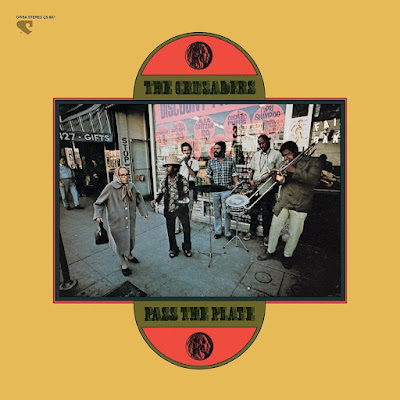
Pass the Plate (Chisa, 1971)
After 1970's Old Socks, New Shoes...New Socks, Old Shoes landed them a spot on the charts briefly for the single "Hard Times" the Crusaders decided on an entirely new approach by making a very small change: they dropped the word "Jazz" from their moniker for 1971's Pass the Plate, the group's final offering on Chisa. Pass the Plate is notable for many things. For starters, a member of the band wrote every composition on it and yet it's a thoroughly modern recording. It begins with trombonist Wayne Henderson's 15- plus-minute title suite that contains no less than five separate parts (the Crusaders were no strangers to the pop music of the era; here they did their own nearly side-long take on what the Beatles accomplished on side two of Abbey Road). The original quartet of Henderson, pianist Joe Sample, saxophonist Wilton Felder, and drummer Stix Hooper are assisted on guitar -- and one assumes on bass since this instrument is uncredited -- by soul and blues legend Arthur Adams. It is a seamless track that allows for the individual abilities of all of its members to shine through as improvisers and displays Henderson's impeccable sense of time, seamlessly melding genres such as gospel, blues, and vintage and latter day soul into jazz. In addition to Adams, there are also uncredited female and male choruses edited into the proceedings at two points (they're in the background and they don't distract) and Philemon Hou, from the Friends of Distinction, adds some "tapping" and "begging" to the mix, bringing it the feel of some good-time street theater. The first side closes with a reprise of the group's first hit of a decade earlier, "Young Rabbits (71-72)," with a brief but tough drum break by Hooper. The second half of the album is almost all Sample. It begins with "Listen and You'll See," one of the pianist's now trademark sleight-of-hand compositions where theme, interlude, bridge, and improvisation all feel like separate tunes until the theme returns at the end. His own Fender Rhodes breaks twinned with Adams' guitar are lean, choppy, and tough while the horn parts are elegant and graceful. Hooper's "Greasy Spoon" is next; it's a tune that would become an enduring part of the group's live show. With its shuffling bluesy frontline -- the horns and guitar -- it's all groove and sounds like its title: all meat and potatoes. "Treat Me Like Ya Treat Yaself," -- Sample's good-natured dig at Sly Stone and Les McCann, follows, but that's in title only. These cats could lay down some of the most sophisticated grooved out funk of the era. Adams plays full wah-wah on both rhythm and his leads, and the horns inside and out with a James Brown-style moves as Sample does his pump-it-up move with simple but effective key changes in the melody, which give way immediately to a wickedly raspy solo by Felder. The funk continues on "Goin' Down South," which feels more like one of Johnny Pate's blaxploitation soundtrack cues than a typical Crusaders tune of the time, but that's a compliment. The album closes on a slow note with the midtempo ballad "Love Can't Grow Where the Rain Won't Fall," a gospel-sounding tuner with direct nods to the Burt Bacharach-Hal David fakebook. Ultimately, like its predecessor, this is arguably the Crusaders at their finest and most accessible to rock and pop audiences of the time, though they didn't give up an inch of the jazz cred they'd established over the previous decade.
vendredi 27 septembre 2024
The Dennis Coffey Band – A Sweet Taste Of Sin 1978
As tepid and weak as a cup of Sanka, A Sweet Taste of Sin suffers mightily from the disco influences that afflict so much of Dennis Coffey's late-'70s output. The sinuously funky, fuzz-laden guitar, monster drums, and innovative studio effects that galvanized LPs like Hair & Thangs and Evolution are long gone, replaced by generic nightclub grooves and anemic production. Worst of all, even Coffey's songs fall flat, hampered by pedestrian melodies and arrangements. The slow-groove title cut is probably the most memorable moment, although "Calling Planet Earth" enjoyed significant disco airplay. DJs seeking more of the kinetic beats found in volume on Coffey's Sussex releases will be most disappointed, however, as only "Love Encounter" and "Gimmie That Funk" feature percussion breaks worth the search-and-rescue effort.
Dennis Coffey - Back Home 1977
With each successive effort for the Westbound label, Dennis Coffey moved further away from the heady funk-rock of his earliest LPs and towards a glossy, unapologetically commercial approach informed by the growing popularity of disco. With Back Home, he essentially abandons funk for good, in the process scoring a major disco hit with "Wings of Fire." But disco is about production, not virtuoso playing, and too much of Back Home stifles Coffey's innovative fretwork in favor of overbaked arrangements and repetitive rhythms. The end result smoothes away the rough edges that made Coffey such an exciting and singular guitarist.
Dennis Coffey - Finger Pickin Good 1975
Dennis Coffey's Westbound debut heralds the tectonic shift away from the synapse-scorching psychedelic funk of his previous records toward a slicker, more commercial approach that anticipates the full-blown disco sensibility of his subsequent outings. Although cuts like the climactic "Wild Child" (yet another variation on Coffey's smash "Scorpio") retain the jazz-rock ferocity of the guitarist's best work, the majority of cuts (most egregiously the juvenile "If You Can't Dance to This, You Got No Business Havin' Feet") fall back on banal string arrangements and tepid beats. Fantastic cover art, though.
Dennis Coffey - Instant Coffey 1974
Dennis Coffey shifts gears with Instant Coffey, belying the record's title with his most ambitious outing to date. If anything, the album is at times too labored for its own good. The 11-minute opener, "Sonata," suffers from its epic pretensions and overwrought string arrangement, although its sinuously funky bridge calls to mind the kinetic energy of Coffey's strongest efforts. "Chicano" likewise benefits from the kind of mind-warping wah-wah guitar Coffey first introduced as a session player on Temptations classics like "Cloud Nine" and "Ball of Confusion," while a superb reading of Lalo Schifrin's "Theme from 'Enter the Dragon'" emphasizes Coffey's skills as an arranger, giving the composition some serious oomph with a thick, richly textured bassline. Best of all is "Outrageous (The Mind Excursion)," a wave of Funkadelic-inspired cosmic slop.
Dennis Coffey & The Detroit Guitar Band - Electric Coffey 1972
Although its myriad zodiac-inspired titles might suggest that Electric Coffey does little but rehash the punishing funk of Dennis Coffey's classics "Scorpio" and "Taurus," in truth it ranks alongside the guitarist's most ambitious and accomplished LPs, exploring a vast swath of musical geography spanning from psychedelic soul to blues-rock. A monster drum break and deep-fried production conspire to make "Son of Scorpio" the sought-after cut among DJs, but Electric Coffey is much more than the sum of its parts. Coffey empties out his bag of studio tricks for "Capricorn's Thing" and "The Sagittarian," while "Love Song for Libra" and the acoustic "Lonely Moon Child" illustrate a newfound grasp of atmosphere and nuance.
Dennis Coffey - Goin For Myself 1972
Goin' for Myself is the third album by session guitarist Dennis Coffey.
Following on the creative and commercial breakthroughs of Evolution, Dennis Coffey's second Sussex LP can't help but suffer by comparison. Though by no means a bad record, Goin' for Myself nevertheless falters from a paucity of new ideas, relying heavily on recycled riffs and ill-suited cover material. "Taurus," the record's hit follow-up to Coffey's funk classic "Scorpio," even borrows elements of the original's melody, while renditions of Simon & Garfunkel's "Bridge Over Troubled Water," the Jackson 5's "Never Can Say Goodbye," and Carole King's "It's Too Late" hinge on the guitarist's now-familiar gimmicks like wah-wah and distortion. But the mid-tempo "Midnight Blue" succeeds on the strength of Coffey's nuanced performance, and the funky "Can You Feel It" is irresistible. Best of all is the incendiary "Ride Sally Ride," later sampled to memorable effect for LL Cool J's "Big Ole Butt."
Dennis Coffey & The Detroit Guitar Band - Evolution 1971
Evolution is the second album by session guitarist Dennis Coffey and the Detroit Guitar Band.
Released in 1971 under the Dennis Coffey and the Detroit Guitar Band banner the album charted at number thirteen on the Top Soul Albums chart due to the funk instrumental "Scorpio" which charted at number six on the U.S. Pop Singles chart and number nine on the US Soul Singles chart.
Dennis Coffey's Sussex label debut remains his most consistent and rewarding LP, not to mention his most commercially successful. Evolution delivers precisely what its title promises, spotlighting Coffey's growth as a guitarist and as a composer. Its infectious centerpiece "Scorpio" reached the R&B Top Ten, buoyed by Coffey's ear-grabbing guitar intro and a Hall of Fame drum break that is the source for an endless number of samples. The leadoff cut, "Getting It On," has proven no less fecund, its opening guitars and Andrew Smith's drums bit off by both the Beastie Boys and Public Enemy. But Evolution also charts the development of Coffey's skills as an arranger, cherry-picking elements of rock, funk, and soul to create a unique sound not too far removed from jazz fusion. Somehow he even transforms Led Zeppelin's blues-rock behemoth "Whole Lotta Love" into a vacuum-packed funk groove.
Dennis Coffey Trio – Hair And Thangs 1969
Dennis Coffey's solo debut offers a primer in psychedelic funk, marshaling fuzz-laden guitar wizardry, deeply soulful organ fills, and rubber-band rhythms to forge one of the most sample-ready records of the late '60s. As its title suggests, Hair and Thangs draws much of its inspiration from the flower-power musical Hair, covering the soundtrack's "Let the Sunshine In," "Aquarius," and "Sodomy." Coffey's trademark guitar distortion suffuses the songs with a grit and edge that effectively undercuts the saccharine flavor of the originals, but also he retains the instincts and humility of a sideman, avoiding pyrotechnics to allow organist Lyman Woodard and drummer Andrew Davis to shine on each cut. The disc's flip side is even more effective, with ingeniously funky readings of the Isley Brothers' "It's Your Thing," Charles Wright's "Do Your Thang," and the Beatles' "Hey Jude." DJs and beat-freaks will find much to sample and savor here.